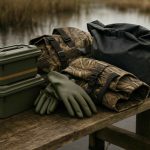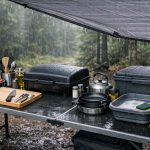
It's surprising how a rainy day brings out the weaknesses of any camp kitchen setup. As well as dampening your food the rain can wash away your fuel and, hidden under a tarp, your cookware will mysteriously disappear seemingly with every meal. Your 'dry gear' can build up rapidly with every dirty utensil, until the search for something dry turns into a soggy muddy slogged search of your packed bags.
Start with a roof, not a pile of gear
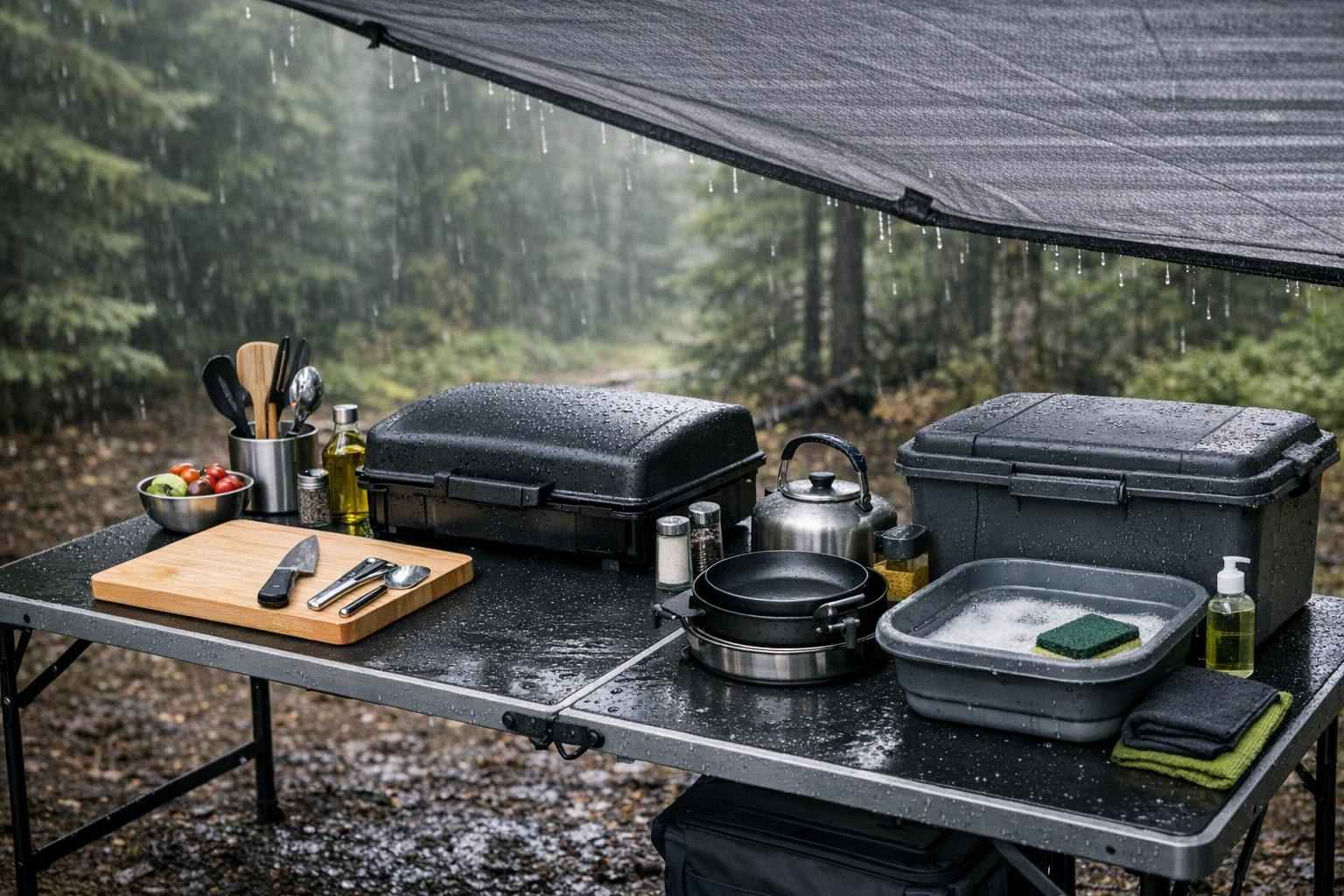
Set up your cooking area in the driest location possible and pitch a tarp or set up an awning so rain does not fall on your food preparation area. Be sure to position the roof of your cover far enough away from your cooking area so that no smoke will be trapped under the tarp and also that heat from your fire will not be transferred to fabric, branches or other combustible materials. Also, make sure there is ample space to safely move around your stove or campfire.
Be aware that covered areas are not entirely weatherproof! Strong winds can be directed under tarps or awnings to drive rain into your camp. Also, be aware of low lying areas that may collect water and slippery bare ground that can get rubbed by boot soles, or by chair legs or even bins.
Position your main table under the best part of the roof for coverage. Place less sensitive items such as your sealed water container or empty wash basin at the outside edge of the area. Items such as food, your dry fuel, paper etc and clean utensils will be best kept inside the tent.
Divide the kitchen into working zones
Divide your wet camp kitchen up into three zones for better organization: preparation, cooking and cleaning. Even the smallest camp has room for three zones when using one table, and storing similar items together will make the camp easier to organize and function.
Divide the camp kitchen into three zones for preparing, cooking and cleaning. Store cutting boards, knives, etc. for the current meal in the preparation zone. In the cooking zone store only the required cookware and tools for the meal being cooked. The cleaning zone needs a separate basin for washing and for drying as well as a container for waste.
Using a second table is only beneficial if one is available. A good quality storage tote can be used as a dry area to store items such as dirty washing, and a compact folding shelf can be positioned on top of the main table to store utensils above the wet surface of the camp kitchen table. Ensure all items are stored off the ground to avoid them getting splashed by ground water and getting lost in mud or dirt.
Use waterproof storage with a purpose
Waterproof containers are most useful when they are assigned to a specific type of item, and then only that type of item is stored in them. This allows for less opening and closing of containers, and less chance of having to search through all of the items in a container to find something when it is needed.
No container, even a hard-sided one, needs to be 100% waterproof. A sturdy bin with a good closing system is best for pots and pans as well as other dry items such as food and gear. Larger amounts of lesser used items such as extra food, camp gear and other items not frequently used can be stored in soft sided bags that are sealed prior to storing them in a hard-sided container.
Don't trust a container's closure until you've checked the lid, the seals and any open top to ensure there are no obvious weaknesses which could fail without warning and allow water in. Ensure any open top is pointed away from you to prevent water running in and make sure that you don't stack items on top of a sealed container's lid as you could cause the seal to fail.
Store items in your shelter in the reverse order that you would use them. So the things that you would need to cook a meal with, should be closest to where you will be doing your cooking, with your current meal in the center of the tools. Items that you have brought with you in case of emergency or that you do not normally use should be stored at the very back of your shelter.
Protect the things that fail when damp
Some things can survive better in damp conditions than others. Pots and pans of metal usually dry rapidly, whereas things made of paper, cardboard, wood or even cloth can rot rapidly. Be sure to move dry food into rigid waterproof containers prior to departure should they be packaged in fragile products which could suffer damage in transit.
Storing your ignition supplies in a waterproof container and opening it when you need something, storing it away from your stove, cooking area and heat sources and storing fuel containers upright and using them in accordance with the product's instructions and the equipment that you are using it with (refer to current requirements and safe practices for different fuels) will make life easier when managing wet weather.
A dry towel for drying hands, cleaning off muddy tools and for drying off wet foods is not a luxury item. Bring extra towels and make sure you have a way to hang them up to dry rather than putting them in your clean gear bin when they get dirty. A simple mesh line or a hanging loop under cover will do to dry items off the cooking surface.
Build a rain routine around each meal
Again, aim to have the best system to prepare and serve meals even in the worst weather. Before you start preparing a meal, remove all the needed food, equipment and utensils from storage. Put all the lids, packaging, etc. that you removed from the containers in one place where they will not get wet or lost.
When eating, ensure that hot dishes are placed in a single, designated area, to be washed later and then packed away. The dirty utensils will be placed in a separate area for cleaning. Do not put a wet lid down on your food preparation area. Instead put it down on a heat safe surface or on the lid of another pot &lean against something to stop it from toppling over.
Finally clean up the food scraps from your meals and all the dirty kitchen utensils and put them in their storage. Be sure to dispose of food waste according to the local regulations for that area as well as that of the campsite where it is located. Also remember to take all scented foods as well as greasy wash water and dispose of it away from camp before you go to sleep.
Dry everything you can, and if an item is to be packed damp, keep it in a separate part of the shelter and mark the container for later. If you pack a sealed box of damp clothes, be aware that they will likely develop mildewy odors and possibly spread moisture to other, clean items of equipment.
Make cleanup and pack-down less fragile
The loss of camp knives, stove parts and small items can occur in the hurried tearing down of a camp kitchen. A small container is best for loose kitchen items. These should be counted and packed before the dismantling of the kitchen begins.
Be sure to wash your dishes and keep them in the same place until you are able to properly clean them. Local water-use and waste-disposal requirements must also be adhered to. Do not assume that a nearby river, lake, stream, etc. can be used for dumping soapy water. If you must wash in such a location, be sure to strain any food particles from the water and pack out any waste. Water can then be dispersed or dumped in accordance with current official regulations.
At pack-down, start with the closed containers of your dry food and then go to cookware, the cleaning supplies and finally the wet materials that comprise the interior of the shelter. Make sure that the lids to your waterproof storage containers are clean enough to close and keep different types of objects in separate categories for drying.
A camp kitchen does not have to consist of many items to function to prepare a meal. A camp kitchen consists of the few items required to enable preparation of a meal while the rest of the camp is dry and clean. Effective wet weather camping is created by effective zoning of areas, the use of appropriate containers to store gear and a clean up routine that works.